 |
|
Billions of dollars of art stolen from Jewish families during the Holocaust remains missing.
|
Holocaust Victims are Still Fighting for Justice – Congress Can Help
|
|
This week the US Senate passed S. 1884, the Holocaust Expropriated Art Recovery Act of 2025. It was a victory for Holocaust survivors trying to reclaim property that the Nazis stole from them, in particular the billions of dollars in stolen art. A companion bill has been introduced in the House. The Republican Jewish Coalition is working hard to help move these bills through the legislative process and bring relief to survivor families.
Joel K. Greenberg writes at The Hill about the congressional action to help Holocaust victims reclaim Nazi-looted art. He explains the background to the current legislation and the time-sensitive need to move it forward.
Greenberg writes:
|
|
In 2016, Congress unanimously passed the Holocaust Expropriated Art Recovery (HEAR) Act to make that restoration possible. The law recognized a simple truth: in the chaotic years after the war, Jewish families were scattered across continents and often unsure who — or what — had survived. During that time, looted art moved through underground markets and into museums, dealers' inventories, auction houses, and private collections around the world. The HEAR Act responded by establishing a clear rule: once a family discovers the location of its stolen art, it has six years to bring a claim.
Yet in the nine years since the law took effect, many courts and museums have worked against that intent.
…Now Congress is considering strengthening and extending the HEAR Act of 2025, as the 2016 Act is set to sunset. It recently passed the Senate Judiciary Committee 22–0, with every Republican and Democrat voting in favor. Yet some museum leaders, including the Association of Art Museum Directors, continue to mount an aggressive campaign to stop it or to impose another sunset clause that would reinstate the very time limits the law was designed to overcome.
…For survivors and their descendants, this may be the last real chance to correct a historic wrong. Congress now faces a stark choice: stand with the victims of the greatest crime in modern history or stand with institutions betting they can run out the clock.
|
|
|
|
|
|
 |
|
James Monroe, Fifth President of the United States, by Gilbert Stuart, Pendleton's Lithography, US Library of Congress.
|
Bringing Back the Monroe Doctrine
|
|
The White House national security strategy document, released the week, includes this declaration:
|
|
The United States will reassert and enforce the Monroe Doctrine to restore American preeminence in the Western Hemisphere, and to protect our homeland and our access to key geographies throughout the region. We will deny non-Hemispheric competitors the ability to position forces or other threatening capabilities, or to own or control strategically vital assets, in our Hemisphere.
|
|
Rich Lowry writes at National Review in praise of President Donald Trump's emphasis on American interests in our own hemisphere. He explains:
|
|
President [James] Monroe, in an annual message to Congress in 1823, issued on his own what would become his eponymous doctrine.
He asserted that "the American continents, by the free and independent condition which they have assumed and maintain, are henceforth not to be considered as subjects for future colonization by any European powers."
New European footholds in the Western Hemisphere were thought to represent not just security but territorial, demographic, and ideological threats.
… [T]he Monroe Doctrine became a predicate of American geopolitical power by avoiding major challenges to our hegemony in our own hemisphere. When we had the means, we enforced it ourselves. Once we were no longer distracted by the Civil War, we pressured France to end its intervention in Mexico in the 1860s. We got Germany to stand down during the Venezuela crisis of 1902 (this event led to the Roosevelt corollary, named after President Teddy Roosevelt, stipulating that the US could deploy "an international police power" when Latin American countries were failing).
Since the 1990s, though, we've let down our guard. China is now Latin America's second-largest trading partner, after the United States, and has expanded its influence in the region on all fronts. Russia has relationships with Venezuela, Nicaragua, and Cuba and has increased its covert operations in Mexico. Hezbollah has a notable presence in Latin America.
|
|
President Trump has already begun using American power to counter these bad actors in our hemisphere. Returning to the Monroe Doctrine is an important realignment of American security policy.
|
|
|
|
|
|
 |
RJC in the News
|
|
RJC Political Director Sam Markstein appeared on Alan Stock's radio show on KXNT in Las Vegas to talk about President Donald Trump's executive order to designate specific chapters of the Muslim Brotherhood as terrorist organizations, other efforts to stop Islamist penetration of American institutions, and the implications of Zohran Mamdani's election as the next mayor of New York City. Listen here.
|
|
|
|
|
|
|
|
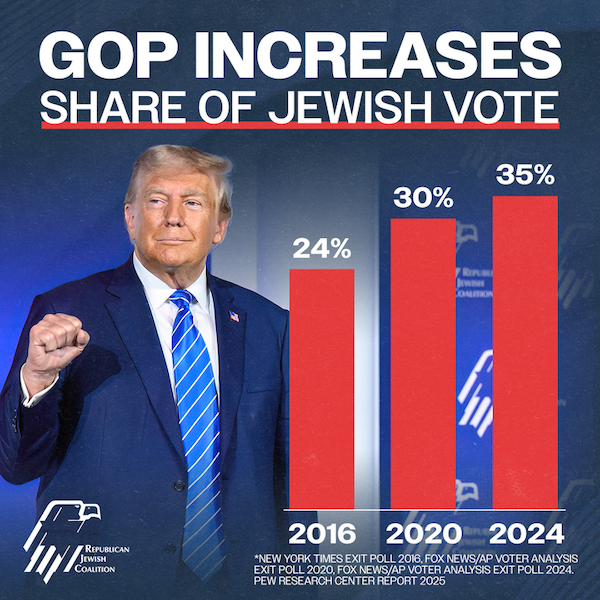
The Pew Research Center showed that President Trump won 35% of the Jewish vote in 2024!
|
Read our exclusive report for details about how the RJC moved voters across America to President Trump and the GOP.
|
|
|
|
 |
Join the Celebration! RJC at 40
|
|
From our start in 1985 to today, the RJC has been a unique, outspoken, and trusted voice for Jewish Republicans, bringing our message to Republican decision makers and the broader Jewish community.
Thank you!
|
|
|
|
|
|
|
Abrams: Eli the Survivor
Elliott Abrams reviews Hostage by Eli Sharabi: "Hostage is a classic work about captivity—joining Natan Sharansky's Fear No Evil about his years in the Gulag, and Viktor Frankl's account in Man's Search for Meaning of his years in Nazi concentration camps—examining the human spirit under the worst possible circumstances. It begins on the morning of Oct. 7 and ends with his release from Gaza after 491 days in captivity—and his visit to the graves of his wife Lianne and his daughters.
"…It's impossible to read Hostage without asking how we would have dealt with these conditions: Would we have fought on and lived? How many of us could have managed one day or 10 with the commitment, courage, and sanity Sharabi maintained for 491 days, holding fast to his "mission" to survive? The story of this very extraordinary ordinary Israeli kibbutznik, this very typical husband and father and son, is a bracing memoir of how men can find the strength within themselves to resist evil and decide to survive. "Therefore choose life," God commanded in Deuteronomy 30:19. That is what Sharabi did, and his story is captivating and inspiring."
|
|
Washington Free Beacon: Trump Energy Department To Finance Up to 10 Nuclear Reactors in Bid To Kickstart Nuclear Energy 'Renaissance'
The Trump Department of Energy is preparing to finance up to 10 nuclear power plants in an effort to usher in a nuclear energy "renaissance," Energy Secretary Chris Wright said in an exclusive interview with the Washington Free Beacon.
…The Energy Department's intent to finance new nuclear projects is an extraordinary signal that the Trump administration is serious about deploying a new wave of nuclear reactors. President Donald Trump has identified nuclear as a strategic sector for shoring up both energy and national security. In May, he set a lofty goal of quadrupling the nation's nuclear capacity over the next decade.
|
|
Freedman: Antisemitism and the Montana Menorahs
To my non-Jewish friends asking what they can do about antisemitism: This Sunday and for the next eight days, light a Hanukkah menorah. It's a small but powerful way to stand shoulder to shoulder with Jewish communities under attack—and it's a tactic that's defeated such hate in America before.
In 1993 Billings, Mont., was rocked by antisemitic attacks from white supremacists seeking to establish an Aryan state. They desecrated the Jewish cemetery and made bomb threats against the synagogue. Then they threw a brick through the bedroom window of a 5-year-old Jewish boy, Isaac Schnitzer, aiming for the menorah on the sill.
…Margaret MacDonald, a Christian resident of Billings… called her pastor, Keith Torney, and asked if the children in Sunday school could draw menorahs and display them in their windows in solidarity with their Jewish neighbors. Torney loved the idea and encouraged other churches to join in.
The initiative caught fire. Hundreds of hand-drawn menorahs appeared in windows around Billings. After the Gazette published a full-page picture of a menorah for readers to cut out and tape to their windows, the hundreds turned into thousands. Even local businesses joined in. The antisemites put up a fight—firing shots into a local Catholic school and smashing the glass panes of a church—but the volume of solidarity overwhelmed them. They eventually retreated from the town.
…Today across the world, synagogues and Jewish symbols are again under attack, and again the advice from well-meaning authorities may be to hide their Hanukkah lights. The correct response is for everyone to make the light brighter, together.
|
|
|
|
Events
|
|
|
 |
|
The first candle of Hanukkah will be lit on Sunday night, December 14.
The RJC wishes you a light-filled and joyous holiday!
|
|
|
|
|
|
NY: Hanukkah Party for RJC Leaders
Join friends and community leaders as we honor the miracle of Hanukkah and the continued strength of the US-Israel relationship.
|
|
More Info
|
|
|
|
|
|
GA: Hanukkah Party
Join us to celebrate the fifth night of Hanukkah in Atlanta with Governor Brian Kemp and First Lady Marty Kemp.
|
|
RSVP
|
|
|
|
|
|
AZ: Hanukkah Party
Celebrate Hanukkah with us in Scottsdale.
|
|
RSVP
|
|
|
|
|
|
CA: Hanukkah Party
RJC and Young Jewish Conservatives will co-host a Shabbat Hanukkah dinner in Los Angeles.
|
|
RSVP
|
|
|
|
|
|
NV: Hanukkah Party
Celebrate the Festival of Lights with us in Las Vegas.
|
|
RSVP
|
|
|
|
|
|
|
|
|
|
Republican Jewish Coalition
50 F Street, N.W., Suite 100 | Washington, DC 20001
202.638.6688 | [email protected]
|
|
|
|