RJC PAC Overview: 2026 Congressional Battlefield
With nine months until the Midterm Election this November, the congressional battlefield is still taking shape. The deadlines to declare a candidacy for the House or Senate have not yet passed in most states. Many incumbents have yet to announce whether they’ll seek reelection. And a few more states are probably going to redraw their congressional districts to benefit the party in power - as Texas and California did last year.
But we know some things already:
- There will be an intense fight for control of the House of Representatives focused on a few dozen genuinely competitive seats (out of 435).
- The Democrats, who currently hold 47 seats in the Senate, believe that momentum is on their side, but also realize the four-seat gain they would need to wrest control of the chamber still looks like a long shot.
- We also know that the President’s approval ratings are predictive of midterm election outcomes, so observers will be tracking that number carefully over the course of the next nine months.
Here is a closer look at the Senate:
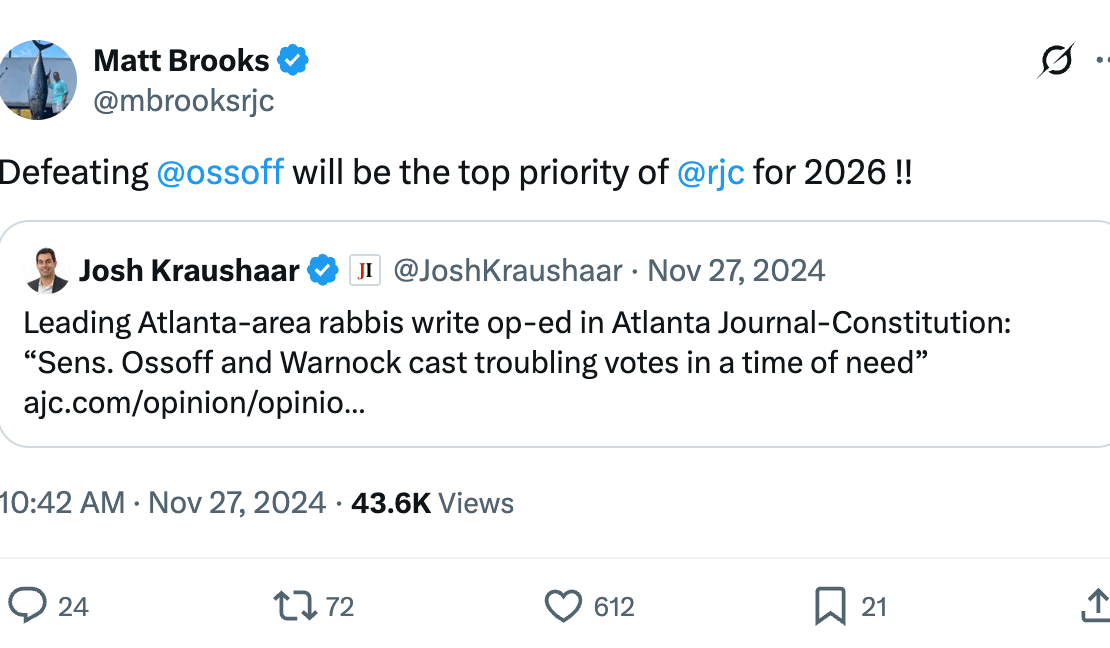
Georgia - The most endangered Senate incumbent in either party is first-term Georgia Democrat Sen. Jon Ossoff, who prevailed by an exceedingly narrow margin in a 2021 run-off in a state that President Trump carried in 2024.
Ossoff has been a great disappointment to Georgians - his Jewish constituents in particular. While the last 2024 votes were still being counted, RJC CEO Matt Brooks announced that:
There are three candidates who could plausibly secure the GOP nomination: Congressman Buddy Carter who has represented Savannah and coastal Georgia since 2015, his House colleague Congressman Mike Collins who has represented areas north of Atlanta since 2023, and first-time candidate Derek Dooley, a former college and professional football coach who is backed by the state’s GOP Governor, Brian Kemp.
Maine - The only GOP incumbent running in a state Kamala Harris carried in 2024 is Maine’s Sen. Susan Collins. Democrats have recruited Gov. Janet Mills, but the 78-year-old Governor is not assured of victory in her primary against left-wing extremist Graham Platner. Either way, Collins has frustrated Democrats’ efforts to flip this seat for thirty years and as Chairwoman of the powerful Senate Appropriations Committee, she is more formidable than ever.
North Carolina - The most competitive Senate race may be the contest to replace retiring Republican Sen. Thom Tillis in North Carolina. President Trump tapped former RNC Chairman Michael Whatley as his choice to protect this GOP-held seat, but Democrats believe that their man, former Governor Roy Cooper, is the best possible candidate to pull off the red-to-blue flip.
AK, OH, TX, IA - Democrats have also recruited experienced challengers to take on GOP incumbents in Alaska, Ohio and Texas, and they’re gunning for the GOP-held open seat in Iowa. Chuck Schumer wants to convince donors that he has a plan to flip the Senate this year, but Democrats haven’t won Senate races in these states in decades.
MI, MN, NH - Meanwhile, Republicans are aggressively targeting the Democrat-held open seats in one state Trump carried in 2024 - Michigan - and two others where he came close: Minnesota and New Hampshire. Sen. Tim Scott, the Chairman of the GOP’s Senate campaign committee, is pleased with GOP recruiting in these states, but it won’t be easy, as illustrated by the fact that a Republican hasn’t won a Michigan Senate race since 1994 and the last Gopher State GOP Senate win - by our National Chairman Norm Coleman - was more than two decades ago.
And now for a closer look at the House:
As 2026 begins, the GOP controls the House of Representatives by an exceedingly narrow margin. The current membership roster consists of 218 Republicans and 213 Democrats. Upcoming special elections to fill four vacancies will narrow the GOP margin to 219-215 for months. On a race-by-race basis, this year's battle for the House is a pure toss-up.
House races are more reflective of the national mood with less attention to individual candidates. For party leaders, the imperative to ensure ‘candidate quality’ is less a matter of recruiting superstars than it is a matter of boxing out unelectable candidates so the party has a capable standard-bearer on the November ballot.
The House battlefield is still taking shape. At least two big states - Virginia and Florida - plan to redraw their districts. And more retirements are expected. We’ll be back in touch with a detailed overview of the battle for the House soon.
We’ll also be watching closely to see how party committees and individual candidates perform in the fundraising race. Party committees and Super PACs will pour resources into key contests after Labor Day, but individual candidates can advertise at lower rates, so a candidate’s ability to fill their own war chest is a key measure of strength.
Making sure campaigns are well funded continues to be of vital importance. That's why the RJC is gearing up for our biggest midterm effort ever through our Political Action Committee, our RJC PAC Portal where you can support congressional candidates directly, and our grassroots activism.